
Energy Storage - Thermal (TES) or Battery (BESS)
Global Energy Demand is Growing rapidly as electrification accelerates in the form of:
AI data centers
Electric vehicles
Housing
Industrial production
As a result, manufacturers need additional capacity
Electricity and natural gas consumption are expected to climb in parallel.
At the same time, organizations with sustainability commitments are working to curb energy intensity through smarter technologies and higher efficiency processes.
Infrastructure Constraints and the Opportunity for Innovation
Despite significant investment, utilities are struggling to expand generation and transmission capacity fast enough to match projected load growth.
This gap creates both a challenge and an opportunity: industries must find ways to grow without relying solely on new fossil fuel extraction or large-scale infrastructure expansion.
Battery Energy Storage Systems (BESS) and Thermal Energy Storage (TES) have emerged as practical, scalable tools that help facilities expand operations, manage energy demand, and improve sustainability performance simultaneously.
Peak Demand Management
Both BESS and TES are widely used to reduce peak electricity demand charges and support load shifting, but they do so in different ways.
BESS is typically best suited for facilities with limited process heat needs—such as commercial buildings or office complexes—where the primary objective is electrical load management.
TES, sometimes paired with a generator set (genset), is advantageous for facilities with significant process heat requirements. In these hybrid configurations, the genset mitigates peak electrical charges while the TES system supplies or stores thermal energy. A TES can be used to recover waste heat that is a bi-product of processing.
Both technologies can provide backup power during outages. However:
BESS is limited by battery capacity and discharge duration.
TES–genset systems can operate as long as fuel is available, offering extended resilience.
Process Heat Advantages
TES offers capabilities that BESS cannot match.
Industries with substantial heating or cooling loads such as food processing, chemical, or heavy manufacturing.
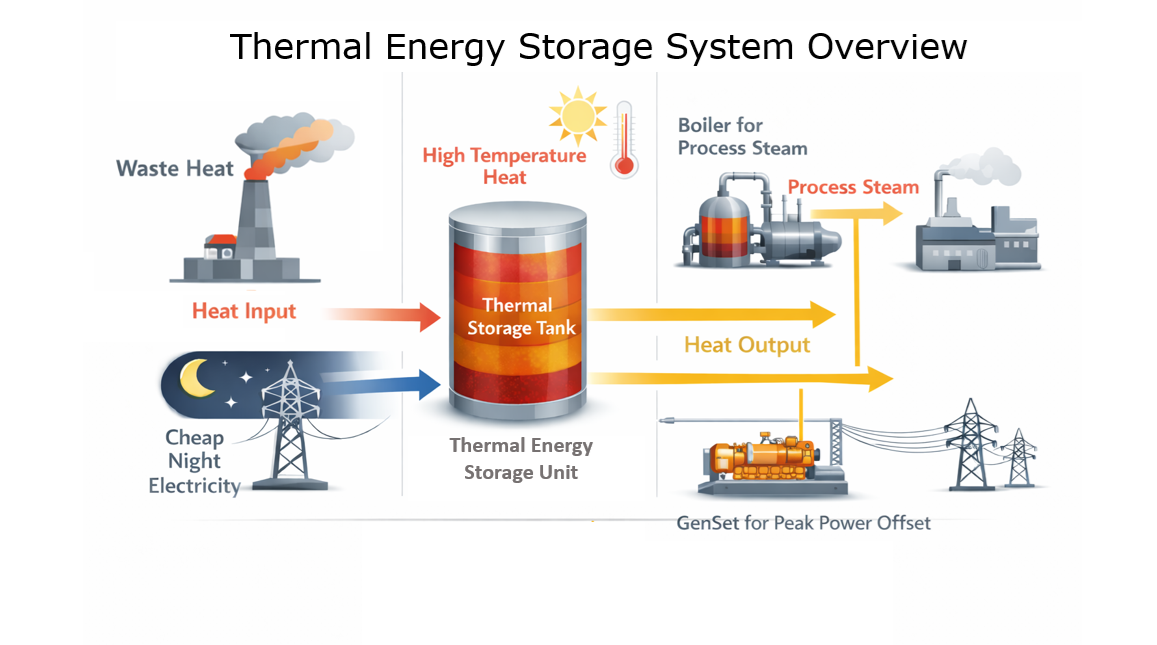
TES systems:
Capture and store waste heat that would otherwise be lost.
Convert off-peak electricity into low-cost thermal energy.
Reduce reliance on natural gas, especially in regions with clean electricity grids like Ontario and Quebec.
Where applicable generate Carbon Credits that contribute to ROI.
These capabilities translate into lower operating costs, reduced emissions, and greater flexibility in managing thermal loads.
Carbon Footprint Considerations
Both technologies support sustainability goals, but their environmental profiles differ.
TES can significantly reduce Scope 1 and Scope 2 emissions. Its storage media, often mineral-based or naturally occurring aggregates, carry relatively low embodied carbon.
TES can generate carbon credits
BESS supports renewable integration and grid optimization but relies on lithium, cobalt, and nickel. These materials require energy-intensive mining and processing, and although recycling is improving, upstream environmental impacts remain a factor.
TES reduces direct emissions from thermal processes, while BESS primarily enhances electrical efficiency and grid flexibility.
Space and Economics
Both technologies at an Industrial scale typically require a similar physical footprint
But economics are dependent upon application.
Space:
BESS: one to four containerized units depending on chemistry and capacity.
TES: two to four containers depending on thermal storage requirements.
Economics:
BESS may offer a better project economics when used strictly for short duration energy storage (e.g. ancillary services and short-term peak shaving).
TES provides an additional value stream—low-cost, on-demand thermal energy with 12+ hours of storage capacity. For facilities with significant heating needs or recoverable waste heat, TES often delivers stronger long-term returns and more comprehensive operational benefits.
Key Takeaways
BESS and TES each play important roles in modern energy management.
When the primary need is electrical demand response and short duration backup power, BESS is often the right fit.
For facilities requiring process heat, steam, hot water, or integrated thermal management alongside electrical demand control, TES offers a more complete and economically compelling solution.
The optimal choice depends on a facility’s operational profile, energy mix, sustainability objectives, and long-term growth strategy.
Want to learn more? Contact us here:
